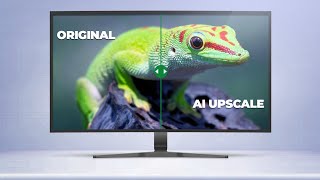
What is Upscaling?
Upscaling is a technique used in artificial intelligence to improve the quality of images or videos by increasing their resolution. This is done by adding new pixels to the image, which are predicted based on the surrounding pixels. The goal of upscaling is to create a higher quality image that is similar to the original, but with more details and a higher resolution.
Think of upscaling like restoring an old painting. Imagine the original painting is like a low-resolution image, with missing details and faded colors. The upscaling algorithm is like a skilled restorer, who uses their knowledge of art and history to fill in the missing details and restore the painting to its original glory. Just as the restorer must be careful not to add too much or too little detail, the upscaling algorithm must balance the level of detail and noise in the output image to create a realistic and high-quality result.
Why does Upscaling matter?
Upscaling is important for practitioners and builders because it allows them to improve the quality of images and videos, which is essential for many applications such as video production, gaming, and virtual reality. Upscaling can also be used to improve the quality of low-resolution images, which can be useful for applications such as facial recognition and object detection. Additionally, upscaling can be used to reduce the amount of data required to store and transmit images and videos, which can be beneficial for applications where bandwidth is limited.
How does Upscaling work?
Upscaling works by using machine learning algorithms such as convolutional neural networks (CNNs) and transformers to predict the missing pixels in an image. These algorithms are trained on large datasets of high-resolution images, which allows them to learn the patterns and features of the images. The upscaling process typically involves several stages, including image preprocessing, feature extraction, and pixel prediction. The output of the upscaling process is a higher resolution image that is similar to the original, but with more details and a higher resolution.
Real-world applications
Upscaling is used in a variety of real-world applications, including video production, gaming, and virtual reality. For example, upscaling can be used to improve the quality of low-resolution videos, which can be useful for applications such as video conferencing and online streaming. Upscaling can also be used to improve the quality of images, which can be useful for applications such as facial recognition and object detection. Additionally, upscaling can be used to reduce the amount of data required to store and transmit images and videos, which can be beneficial for applications where bandwidth is limited.
Common misconceptions
One common misconception about upscaling is that it can always produce high-quality images. However, the quality of the output image depends on the quality of the input image and the complexity of the upscaling algorithm. Another misconception is that upscaling is only used for images and videos, when in fact it can be used for other types of data such as audio and 3D models.
Limitations and Future Directions
Upscaling is a rapidly evolving field, and there are many potential applications and limitations to consider. For example, upscaling can be computationally intensive, which can make it difficult to use in real-time applications. Additionally, upscaling can be sensitive to the quality of the input data, which can make it difficult to use in applications where the input data is noisy or of poor quality. Despite these limitations, upscaling has the potential to revolutionize many fields, including video production, gaming, and virtual reality.