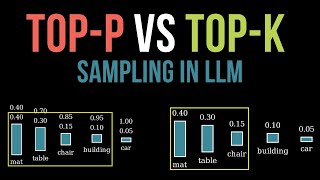
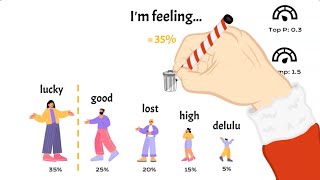
Top-p sampling is a technique used in natural language processing to generate text. It works by selecting the next word in a sequence based on its probability of being the correct choice. This probability is calculated by a language model, which is trained on a large dataset of text. The 'p' in top-p sampling refers to the proportion of the probability distribution that is considered when making the selection.
The process of top-p sampling involves calculating the probabilities of all possible next words in a sequence. The probabilities are then sorted in descending order, and the top-p proportion of the probabilities is selected. This means that only the words with the highest probabilities are considered as possible next words. The selected word is then chosen randomly from the top-p proportion, with the probability of selection proportional to its probability.
Top-p sampling is often used in language models to generate coherent and natural-sounding text. It is particularly useful in applications such as chatbots and language translation, where the generated text needs to be grammatically correct and fluent. By selecting the next word based on its probability, top-p sampling helps to ensure that the generated text is consistent with the context and the language model's training data.
One of the benefits of top-p sampling is that it allows for more control over the generated text. By adjusting the value of p, it is possible to trade off between the coherence and the diversity of the generated text. A lower value of p will result in more coherent text, but may also lead to repetition and lack of diversity. A higher value of p will result in more diverse text, but may also lead to incoherence and errors.
Overall, top-p sampling is a powerful technique for generating text with language models. It provides a balance between coherence and diversity, and can be fine-tuned to suit specific applications and requirements. By understanding how top-p sampling works, it is possible to design more effective language models and generate high-quality text.
Think of top-p sampling like a committee decision-making process. Imagine a group of experts, each with a different opinion on what the next word should be. The top-p sampling technique is like selecting a subset of the most confident experts and then randomly choosing one of their opinions. This ensures that the selected word is not only likely to be correct but also diverse and interesting, much like a well-rounded committee decision.