What is Temperature?
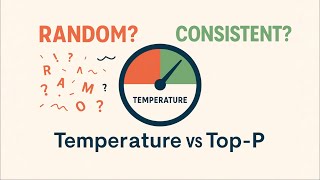
Temperature in AI refers to a technique used to control the randomness of a model's output. This is particularly useful in models that generate text or images, as it allows for more varied or more focused results. By adjusting the temperature, developers can influence the level of creativity or unpredictability in the generated content.
Think of temperature in AI like the thermostat in your home. Just as the thermostat controls the warmth or coolness of your living space, temperature in AI controls the level of randomness or creativity in a model's output. Imagine you're having a conversation with a chatbot, and you want it to be more engaging and spontaneous - that's like turning up the thermostat, making the conversation warmer and more lively.
Why does Temperature matter?
Temperature matters because it gives developers a way to fine-tune the behavior of their models. In applications such as chatbots or language translation, a lower temperature can result in more predictable and conservative outputs, while a higher temperature can lead to more innovative but potentially inaccurate responses. This is especially important when working with models like transformers, which are known for their ability to generate human-like text.
How does Temperature work?
Temperature works by introducing a parameter that controls the softmax function, which is used to normalize the output of a model. The softmax function maps the input to a probability distribution over all possible outputs. By adjusting the temperature, the model can produce more or less dispersed output distributions. A lower temperature results in a more concentrated distribution, meaning the model is more confident in its top choice, while a higher temperature leads to a more uniform distribution, indicating less confidence and more randomness in the output.
Real-world applications
Temperature is used in various real-world applications, including text generation, image synthesis, and even music composition. For example, in a chatbot, a lower temperature might be used for formal or customer-facing interactions, while a higher temperature could be used for more creative or entertainment-focused applications. Similarly, in image synthesis, temperature can be used to control the level of detail or realism in generated images.
Common misconceptions
One common misconception about temperature is that it directly controls the quality of the output. However, temperature primarily influences the variability of the output, with higher temperatures leading to more diverse but not necessarily better results. Another misconception is that temperature is a model-specific parameter, when in fact it can be applied to a wide range of models, including those using embeddings for input representation.
Future directions
As AI models become more sophisticated, the role of temperature in controlling their behavior will continue to evolve. Future research may focus on developing more nuanced and context-dependent temperature control mechanisms, allowing for even finer-grained control over model output. This could involve integrating temperature with other techniques, such as training data augmentation or transfer learning, to create more robust and adaptable models.