What is Data Augmentation?
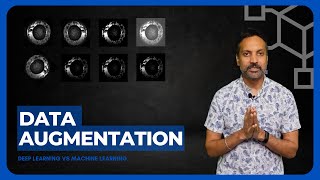
Data augmentation is a technique used to increase the diversity of training data by applying transformations to existing data. This helps machines learn to recognize patterns and make predictions more accurately. By artificially expanding the size of the training dataset, data augmentation reduces the risk of overfitting and improves the model's ability to generalize to new, unseen data.
Think of data augmentation like a photographer taking multiple shots of the same scene from different angles and lighting conditions. Imagine a child learning to recognize objects, not just from a single view, but from many different perspectives and contexts. By providing a model with a diverse set of examples, data augmentation helps it learn to recognize patterns and make predictions more accurately, just like the child learns to recognize objects in different situations.
Why does Data Augmentation matter?
Data augmentation matters because it allows practitioners to build more robust models with limited data. In many cases, collecting and labeling large datasets can be time-consuming and expensive. Data augmentation helps alleviate this problem by generating new training examples from existing ones, which can be especially useful for tasks like image and speech recognition. This technique is often used in conjunction with other methods, such as transfer learning and embeddings, to enhance model performance.
How does Data Augmentation work?
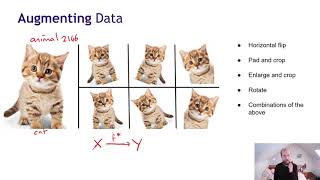
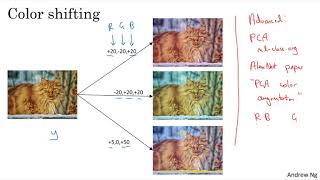
Data augmentation works by applying random transformations to the training data, such as rotation, flipping, and cropping for images, or time stretching and pitch shifting for audio. These transformations can be used alone or in combination to create new, unique examples that are similar to the original data. For instance, a model trained on images of dogs might be augmented with rotated and flipped versions of the same images, allowing it to learn features that are invariant to orientation. This process can be automated using techniques like transformers and generative models.
Real-world applications
Data augmentation has many real-world applications, including self-driving cars, medical imaging, and speech recognition. For example, self-driving cars use data augmentation to generate new scenarios and environments, allowing them to learn how to navigate complex situations. In medical imaging, data augmentation helps models learn to recognize abnormalities and diseases from limited datasets. Speech recognition systems also rely on data augmentation to improve their ability to recognize spoken words and phrases in different accents and environments.
Common misconceptions
One common misconception about data augmentation is that it can completely replace the need for large, diverse datasets. While data augmentation can certainly help, it is not a substitute for high-quality, representative data. Another misconception is that data augmentation is only useful for image and speech recognition tasks, when in fact it can be applied to any type of data, including text and time series data.
Future directions
As machine learning continues to evolve, data augmentation is likely to play an increasingly important role in the development of more robust and generalizable models. Future research directions may include the use of generative models and adversarial training to create more realistic and diverse augmented data, as well as the application of data augmentation to new domains and tasks.