What is Ground Truth?
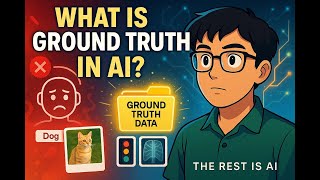
Ground truth refers to the actual, accurate data or information that is used as a reference point to evaluate the performance of an AI model. This data is considered the absolute truth, against which the model's predictions or outputs are compared. It is typically collected through manual labeling or other reliable methods.
Think of ground truth like a map that shows the actual location of a treasure chest. Just as the map is essential for finding the treasure, ground truth data is essential for evaluating the performance of an AI model. Imagine trying to navigate a new city without a map - you might get close to your destination, but you'll never be sure if you've actually arrived. Similarly, without ground truth data, AI models are like navigating without a map, making it difficult to know if they are performing well or not.
Why does Ground Truth matter?
The ground truth is crucial in machine learning because it allows practitioners to assess the accuracy and reliability of their models. Without high-quality ground truth data, it is impossible to know whether a model is performing well or not. This, in turn, affects the model's ability to make accurate predictions or decisions, which can have significant consequences in real-world applications.
How does Ground Truth work?
In practice, ground truth data is used to train and evaluate AI models, such as those using transformers or embeddings. The process involves collecting and labeling a large dataset, which is then used to fine-tune the model's parameters. The model's performance is evaluated by comparing its predictions to the ground truth data, allowing practitioners to identify areas for improvement and refine the model accordingly.
Real-world applications
Ground truth is used in a wide range of applications, including image classification, natural language processing, and speech recognition. For example, in self-driving cars, ground truth data is used to train models to recognize objects and make accurate predictions about their surroundings. Similarly, in medical diagnosis, ground truth data is used to train models to detect diseases and make accurate predictions about patient outcomes.
Common misconceptions
One common misconception about ground truth is that it is always 100% accurate. However, in reality, ground truth data can be noisy or incomplete, which can affect the performance of the model. Another misconception is that ground truth is only necessary during the training phase, when in fact it is also essential for evaluating and refining the model during deployment.
Limitations and Future Directions
The quality and availability of ground truth data can be a significant limitation in many applications. As AI models become increasingly complex and autonomous, there is a growing need for high-quality ground truth data to ensure their reliability and accuracy. Researchers are exploring new methods for collecting and labeling ground truth data, such as using active learning or crowdsourcing techniques, to address these challenges.