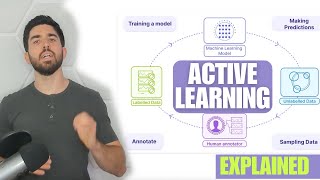
What is Active Learning?
Active learning is a technique used in machine learning to improve the accuracy of AI models by selectively choosing the most informative data for human annotation, rather than relying on random sampling or exhaustive labeling. This approach helps to reduce the need for large amounts of labeled training data, which can be time-consuming and costly to obtain. By focusing on the most uncertain or informative samples, active learning can achieve better performance with fewer labeled examples.
Think of active learning like a student who is trying to learn a new language. Imagine the student has a large stack of flashcards with words on them, but they don't know which ones are the most important to study. Active learning is like a smart tutor that selects the most difficult or uncertain flashcards for the student to study first, so they can learn the language more efficiently. Think of the flashcards as the data points, and the tutor as the active learning algorithm that selects the most informative ones for annotation.
Why does Active Learning matter?
Active learning is particularly useful when working with limited budgets or when dealing with complex tasks that require a large amount of labeled data, such as image or speech recognition. Practitioners care about active learning because it enables them to build more accurate models with less data, which can lead to cost savings and faster development times. Additionally, active learning can be used in conjunction with other techniques, such as transfer learning and embeddings, to further improve model performance.
How does Active Learning work?
Active learning typically involves an iterative process, where the AI model is trained on a small initial set of labeled data and then used to make predictions on a larger pool of unlabeled data. The model then selects the most uncertain or informative samples from the unlabeled pool and requests human annotation. This process is repeated until a stopping criterion is met, such as a desired level of accuracy or a maximum number of iterations. The selected samples are typically those that the model is most unsure about, such as samples that are close to the decision boundary or have a high degree of uncertainty.
Real-world applications
Active learning is used in a variety of applications, including image classification, natural language processing, and speech recognition. For example, active learning can be used to improve the accuracy of self-driving cars by selectively labeling the most informative images or sensor data. It can also be used in medical diagnosis to identify the most relevant patient data for annotation, such as medical images or clinical notes. Additionally, active learning can be used in customer service chatbots to improve their ability to understand and respond to user queries.
Common misconceptions
One common misconception about active learning is that it requires a large amount of labeled data to start with, which is not the case. Active learning can be used with small initial sets of labeled data and can even be used to label data from scratch. Another misconception is that active learning is only useful for simple tasks, when in fact it can be used for a wide range of tasks, from image classification to complex decision-making problems. Active learning can also be used in conjunction with other AI techniques, such as transformers and training data augmentation, to further improve model performance.