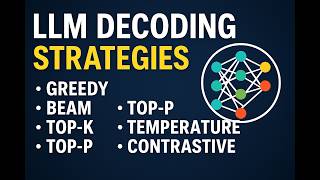
Greedy decoding is a technique used in natural language processing and machine learning to generate text or sequences. It works by selecting the most likely next word or token at each step, based on the context and the model's predictions. This approach is fast and efficient, but may not always produce the best results. The model makes a decision based on local optimization, without considering the overall sequence.
Greedy decoding is often used in sequence-to-sequence models, such as language translation or text summarization. These models take in a sequence of words or tokens and generate a new sequence as output. The greedy decoding algorithm makes a prediction at each step, and then uses that prediction as input for the next step. This process continues until the end of the sequence is reached.
One of the limitations of greedy decoding is that it can get stuck in local optima. This means that the model may choose a word or token that seems likely at the time, but ultimately leads to a suboptimal sequence. To avoid this, other decoding techniques such as beam search or sampling can be used. These methods consider multiple possible sequences and choose the one that is most likely to be correct.
Despite its limitations, greedy decoding remains a popular choice for many applications. It is fast and efficient, and can produce good results when the model is well-trained and the sequence is relatively short. However, for more complex tasks or longer sequences, more advanced decoding techniques may be needed. Researchers and developers continue to explore new methods and refine existing ones to improve the accuracy and effectiveness of sequence generation models.
In practice, greedy decoding is often used as a baseline or a starting point for more complex decoding algorithms. By comparing the results of greedy decoding to other methods, developers can evaluate the effectiveness of their models and identify areas for improvement. This can help to refine the model and improve its performance on a wide range of tasks and applications.
Think of greedy decoding like a hiker who always chooses the most obvious path at each fork in the trail. Imagine they are trying to reach a mountain summit, and at each intersection, they choose the path that seems most likely to lead them to the top. While this approach may work well for simple trails, it can lead to problems on more complex terrain, where a more nuanced approach may be needed to reach the destination.