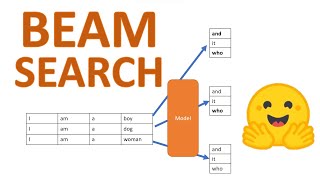
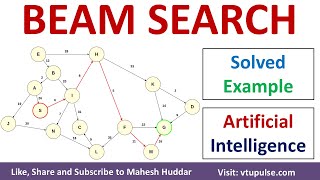
Beam search is a technique used in artificial intelligence to find the most likely sequence of words in a sentence. It's commonly used in natural language processing tasks, such as machine translation and text summarization. The goal of beam search is to identify the best possible sequence of words that maximizes the probability of the sentence being correct. This is achieved by maintaining a set of candidate sequences, known as the beam, and iteratively expanding and pruning them based on their probabilities.
The beam search algorithm works by starting with an initial set of candidate sequences, typically consisting of a single word or a short phrase. At each step, the algorithm expands the beam by generating new candidate sequences that are one word longer than the previous ones. The new sequences are then evaluated based on their probabilities, and the top-scoring sequences are retained in the beam, while the lower-scoring ones are discarded.
The size of the beam is a critical parameter in the beam search algorithm, as it controls the trade-off between computational efficiency and the quality of the results. A larger beam size allows the algorithm to explore more candidate sequences, but it also increases the computational cost. On the other hand, a smaller beam size reduces the computational cost, but it may lead to suboptimal results.
Beam search has several advantages over other sequence generation techniques, including its ability to handle long-range dependencies and its robustness to noise and errors. However, it can be computationally expensive and may require significant computational resources for large-scale applications. Despite these limitations, beam search remains a widely used and effective technique in many AI applications.
In practice, beam search is often used in combination with other techniques, such as attention mechanisms and recurrent neural networks, to achieve state-of-the-art results in natural language processing tasks. By leveraging the strengths of these techniques, beam search can be used to develop highly accurate and efficient AI models that can generate high-quality text and speech.
Think of beam search like a GPS navigation system, where the algorithm is trying to find the best route to a destination. Imagine you're driving through a city, and the GPS is constantly evaluating different routes and adjusting the path based on traffic and road conditions. Similarly, beam search evaluates different sequences of words and adjusts the path based on their probabilities, ultimately finding the most likely sequence that leads to the correct destination.