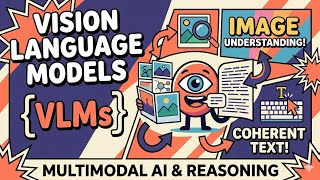
A Vision-Language Model (VLM) is a type of artificial intelligence model that can understand and process both visual and textual data. This allows the model to comprehend the relationship between images and the text that describes them. VLMs are trained on large datasets of images and their corresponding captions or descriptions. The model learns to identify objects, scenes, and actions in images, and to generate text that accurately describes them.
VLMs have many potential applications, including image captioning, visual question answering, and text-to-image synthesis. They can be used to generate captions for images, answer questions about the content of an image, or even create new images based on a given text description. This technology has the potential to improve accessibility for visually impaired individuals, and to enhance the user experience in a variety of applications.
The training process for VLMs involves feeding the model large amounts of data, including images and their corresponding captions or descriptions. The model learns to identify patterns and relationships between the visual and textual data, and to generate text that accurately describes the images. This process requires significant computational resources and large amounts of data, but the results can be impressive.
One of the key challenges in developing VLMs is ensuring that the model can generalize well to new, unseen data. This requires careful tuning of the model's parameters and architecture, as well as the use of techniques such as data augmentation and regularization. Additionally, VLMs can be sensitive to bias in the training data, which can result in inaccurate or unfair results.
Despite these challenges, VLMs have the potential to revolutionize the way we interact with visual and textual data. They can be used to improve accessibility, enhance the user experience, and even create new forms of art and entertainment. As the technology continues to evolve, we can expect to see new and innovative applications of VLMs in a variety of fields.
Think of a Vision-Language Model as a highly skilled translator who can interpret images and text in multiple languages. Imagine a person who can look at a picture and instantly generate a detailed description of what they see, including the objects, scenes, and actions depicted in the image. This person can also take a written description and generate an image that accurately represents the text, much like a skilled artist bringing a story to life.