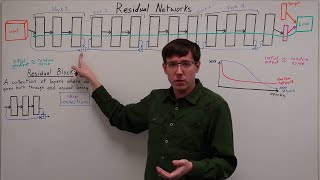
Residual connections are a key component in deep learning models, particularly in neural networks. They allow the model to learn much deeper and more complex representations than previously possible. By adding a residual connection, the model can preserve the information from previous layers and add it to the current layer's output. This helps the model to learn and generalize better. The residual connection also helps to alleviate the vanishing gradient problem, which occurs when the gradients used to update the model's weights become very small.
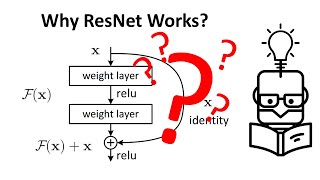
Residual connections were first introduced in the ResNet model, which won the ImageNet competition in 2015. Since then, they have become a standard component in many state-of-the-art models. The idea behind residual connections is simple: instead of trying to learn a complex mapping from the input to the output, the model learns the residual, or the difference between the input and the output. This makes it easier for the model to learn and generalize.
The residual connection is typically implemented by adding the input of a layer to its output. This is done using a skip connection, which allows the model to bypass certain layers and add the input directly to the output. The residual connection can be used in conjunction with other techniques, such as batch normalization and convolutional layers. By combining these techniques, models can learn to recognize complex patterns in data and make accurate predictions.
One of the benefits of residual connections is that they allow models to learn much deeper representations than previously possible. This is because the residual connection helps to preserve the information from previous layers and add it to the current layer's output. As a result, models with residual connections can learn to recognize complex patterns in data and make accurate predictions, even when the data is highly variable or noisy.
Overall, residual connections are a powerful tool in deep learning, allowing models to learn complex representations and make accurate predictions. By preserving the information from previous layers and adding it to the current layer's output, residual connections help models to learn and generalize better, and are a key component in many state-of-the-art models.
Think of a residual connection like a shortcut in a recipe. Imagine you're trying to make a complex dish, and you need to add a certain ingredient at multiple stages of the process. Instead of trying to recreate the entire recipe from scratch each time, you can use a shortcut to add the ingredient directly to the final product, saving time and effort. Similarly, a residual connection allows a model to add the input directly to the output, preserving the information from previous layers and making it easier to learn and generalize.
![Residual Networks (ResNet) [Physics Informed Machine Learning]](https://img.youtube.com/vi/w1UsKanMatM/mqdefault.jpg)