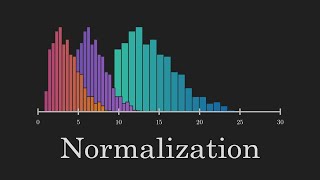
Normalization is a technique used in data processing to scale numeric data to a common range, usually between 0 and 1. This helps algorithms to treat all features equally, preventing features with large ranges from dominating the model. Normalization is particularly important in machine learning, where it can improve model performance and prevent overfitting. It can be applied to various types of data, including images, text, and audio.
There are different normalization techniques, including min-max scaling, z-score normalization, and logarithmic scaling. Each technique has its strengths and weaknesses, and the choice of technique depends on the specific problem and data. For example, min-max scaling is simple and efficient, but it can be sensitive to outliers. Z-score normalization, on the other hand, is more robust to outliers but can be computationally expensive.
Normalization can be applied to both continuous and categorical data. For continuous data, normalization involves scaling the data to a common range. For categorical data, normalization involves converting the data into a numerical representation, such as one-hot encoding. Normalization can also be applied to text data, where it involves converting text into numerical vectors using techniques such as word embeddings.
The benefits of normalization include improved model performance, reduced overfitting, and increased interpretability. Normalization can also help to reduce the impact of outliers and noisy data. However, normalization can also have some drawbacks, such as changing the distribution of the data and introducing bias. Therefore, it is essential to carefully evaluate the effects of normalization on the data and the model.
In practice, normalization is often performed using libraries and frameworks, such as scikit-learn and TensorFlow. These libraries provide a range of normalization techniques and tools, making it easy to apply normalization to different types of data. Additionally, many machine learning algorithms, such as neural networks and decision trees, have built-in normalization capabilities, making it easy to normalize data as part of the training process.
Think of normalization like adjusting the volume on your phone. Just as you need to adjust the volume to a comfortable range to hear music or voices clearly, normalization adjusts the scale of data to a common range to help algorithms understand it better. Imagine trying to listen to music with the volume turned up too high - it can be overwhelming and distorted. Similarly, data that is not normalized can be overwhelming and distorted for algorithms, leading to poor performance and accuracy.