Multitask learning is a technique used in artificial intelligence where a single model is trained to perform multiple tasks simultaneously. This approach can improve the performance of each individual task by leveraging the shared knowledge and features across tasks. By learning multiple tasks together, the model can identify common patterns and relationships that might not be apparent when learning each task separately. This can lead to more efficient use of data and improved overall performance.
Multitask learning can be particularly useful when the tasks are related or have some overlap in their requirements. For example, a model trained to recognize objects in images and also to detect their locations can benefit from the shared knowledge of object features and spatial relationships. The model can learn to recognize objects more accurately by also considering their locations and contexts.
One of the key benefits of multitask learning is its ability to reduce overfitting. When a model is trained on a single task, it may become too specialized and fail to generalize well to new data. By learning multiple tasks, the model is forced to be more general and robust, which can improve its performance on each individual task. Additionally, multitask learning can help to identify the most important features and patterns that are relevant across tasks.
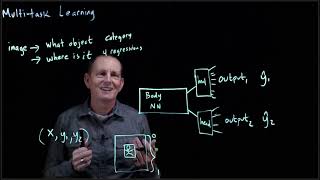
Implementing multitask learning typically involves modifying the model architecture to accommodate multiple tasks. This can be done by adding multiple output layers or by using a shared representation that is fine-tuned for each task. The model is then trained on a combined loss function that balances the performance across all tasks. The choice of tasks and the way they are combined can significantly impact the performance of the model.
Overall, multitask learning is a powerful technique for improving the performance and efficiency of artificial intelligence models. By leveraging the shared knowledge and features across tasks, multitask learning can lead to more accurate and robust models that are better suited to real-world applications.
Think of multitask learning like a student taking multiple classes at once. Just as the student can apply the knowledge and skills learned in one class to another, a model trained with multitask learning can apply the features and patterns learned from one task to improve its performance on other tasks. Imagine a student learning to play the piano and also studying music theory - the two skills are related and can inform each other, leading to better overall performance.