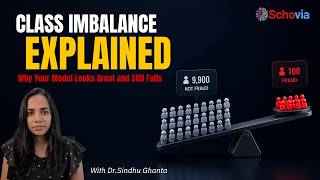
What is Class Imbalance?
Class imbalance is a problem that arises when the data used to train a machine learning model is not evenly distributed among different classes or categories. This can lead to biased models that perform well on the majority class but poorly on the minority class. For instance, in a dataset of images where 99% are of one type and 1% are of another, a model may learn to always predict the majority class.
Think of class imbalance like a scales of justice that are unevenly weighted. Imagine you are trying to learn a new sport, but all the training sessions are focused on one particular skill, while another important skill is barely covered. As a result, you may become very good at the first skill, but struggle with the second, even though it is equally important. Similarly, when a model is trained on imbalanced data, it may become very good at predicting the majority class, but struggle with the minority class, leading to biased and unreliable results.
Why does Class Imbalance matter?
Class imbalance matters because it can significantly impact the performance and reliability of machine learning models, especially in applications where the minority class is the one of interest. Practitioners and builders care about this because it can lead to false negatives or false positives, which can have serious consequences in real-world applications, such as disease diagnosis or credit risk assessment. The use of techniques like training data balancing and embeddings can help mitigate this issue.
How does Class Imbalance work?
Class imbalance works by affecting the way a model learns from the data. When the data is imbalanced, the model may become biased towards the majority class and fail to learn the patterns and characteristics of the minority class. This can be due to the model's objective function, which is often designed to optimize overall performance, rather than performance on each class. Techniques like oversampling the minority class, undersampling the majority class, or using class weights can help to address this issue, and are often used in conjunction with other AI concepts, such as transformers and transfer learning.
Real-world applications
Class imbalance has real-world applications in many fields, including healthcare, finance, and security. For example, in disease diagnosis, the minority class may be the patients with the disease, while the majority class is the healthy patients. In credit risk assessment, the minority class may be the individuals who are likely to default on their loans. In these cases, it is especially important to address class imbalance to ensure that the model is fair and reliable. The use of techniques like data augmentation and generative models can also help to improve the performance of models in the presence of class imbalance.
Common misconceptions
One common misconception about class imbalance is that it can be solved simply by collecting more data. However, this is not always the case, as the new data may also be imbalanced. Another misconception is that class imbalance only affects certain types of models, when in fact it can affect any model that is trained on imbalanced data. By understanding the causes and consequences of class imbalance, practitioners can take steps to address it and develop more reliable and fair models, using techniques like ensemble methods and regularization.
Addressing Class Imbalance
Addressing class imbalance requires a combination of data preprocessing techniques, such as oversampling or undersampling, and modifications to the model's objective function, such as the use of class weights. Additionally, the use of techniques like transfer learning and domain adaptation can help to improve the performance of models in the presence of class imbalance. By using these techniques, practitioners can develop models that are more fair, reliable, and accurate, even in the presence of class imbalance.