What is Style Transfer?
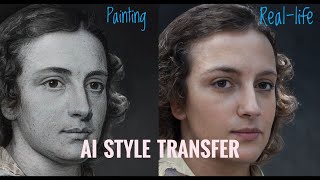
Style transfer is a technique used in artificial intelligence to change the style of an image to match the style of another image, while keeping the content of the original image intact. This is achieved through the use of neural networks, specifically convolutional neural networks, which are trained on large datasets of images. The goal of style transfer is to create a new image that combines the content of one image with the style of another, resulting in a unique and often interesting visual effect.
Think of style transfer like a costume designer who takes a person's clothes and changes the fabric, color, and pattern to match a different style, while keeping the same overall shape and design. Imagine being able to take a black and white photo of a city and change it to look like a watercolor painting, or taking a portrait of a person and changing it to look like a painting by Van Gogh. Style transfer is like a digital version of this process, allowing us to take an image and change its style to match another, while keeping the same content and features.
Why does Style Transfer matter?
Style transfer matters because it has many practical applications in fields such as art, design, and entertainment. For example, it can be used to convert black and white images to color, or to change the style of a painting to match the style of a famous artist. Style transfer also has the potential to be used in more serious applications, such as changing the style of medical images to make them easier to interpret. Practitioners and builders care about style transfer because it allows them to create new and interesting visual effects, and to explore the possibilities of artificial intelligence in the field of art and design.
How does Style Transfer work?
Style transfer works by using a neural network to analyze the content and style of two images, and then combining them to create a new image. The neural network is trained on a large dataset of images, and learns to identify the features that make up the content and style of each image. The content of an image is made up of the objects and features that are present in the image, while the style is made up of the way that those objects and features are presented. The neural network uses this information to create a new image that combines the content of one image with the style of another, using techniques such as embeddings and transformers to generate the new image.
Real-world applications
Style transfer has many real-world applications, including art and design, entertainment, and education. For example, it can be used to create special effects in movies and video games, or to generate new images for use in advertising and marketing. It can also be used in education, to help students learn about art and history by allowing them to see famous paintings in different styles. For instance, a student could see a painting by Van Gogh in the style of Picasso, or a photograph of a city in the style of a watercolor painting.
Common misconceptions
One common misconception about style transfer is that it is only used for artistic purposes, when in fact it has many practical applications. Another misconception is that style transfer is a simple process, when in fact it requires a large amount of computational power and complex algorithms, including training data and neural networks. Style transfer is often confused with other techniques, such as image filtering, but it is a distinct technique that allows for the combination of two images in a unique and interesting way.
Future developments
The field of style transfer is constantly evolving, with new techniques and applications being developed all the time. One area of research is in the use of style transfer for generating new images, rather than just combining existing ones. This has the potential to be used in a wide range of applications, from art and design to entertainment and education. As the field continues to evolve, we can expect to see new and interesting developments in the use of style transfer, including the integration with other AI concepts such as transformers and embeddings.