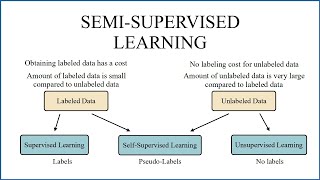
Semi-supervised learning is a type of machine learning that uses a combination of labeled and unlabeled data to train models. This approach is useful when labeled data is scarce or expensive to obtain. By leveraging the structure of the unlabeled data, semi-supervised learning can improve the accuracy of models. The technique is particularly useful in applications where data is abundant but labeling is time-consuming.
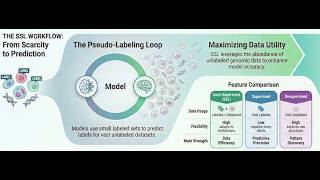
Semi-supervised learning works by first training a model on the labeled data, and then using the unlabeled data to refine the model's predictions. The model can learn to identify patterns and relationships in the data, even if it's not explicitly labeled. This approach can be especially useful in applications such as image recognition, where labeling large datasets can be time-consuming.
One of the key benefits of semi-supervised learning is that it can reduce the need for labeled data. This can be especially useful in applications where data is abundant, but labeling is expensive or time-consuming. By using semi-supervised learning, organizations can build more accurate models without having to invest in large-scale labeling efforts.
Semi-supervised learning can be used in a variety of applications, including image recognition, natural language processing, and recommender systems. The technique is particularly useful in situations where data is complex or high-dimensional, and where labeling is difficult or expensive. By leveraging the structure of the unlabeled data, semi-supervised learning can help organizations build more accurate and effective models.
Overall, semi-supervised learning is a powerful technique that can help organizations build more accurate models without requiring large amounts of labeled data. By leveraging the structure of the unlabeled data, semi-supervised learning can improve the accuracy of models and reduce the need for labeling efforts. This can be especially useful in applications where data is abundant, but labeling is time-consuming or expensive.
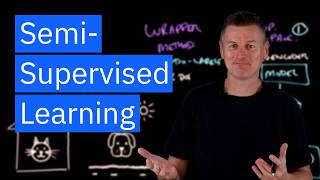
Think of semi-supervised learning like a child learning to recognize objects. Imagine a child is shown a few pictures of cats and dogs, and then is given a large stack of unlabeled pictures. The child can use the labeled pictures to learn the basic characteristics of cats and dogs, and then use the unlabeled pictures to refine their understanding. Over time, the child can become very good at recognizing cats and dogs, even if they've never seen the specific picture before.