What is Orchestration?
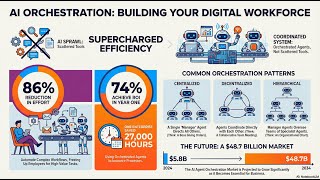
Orchestration in AI refers to the process of managing and coordinating multiple systems, models, or services to work together in a harmonious and efficient manner. This involves designing and implementing workflows that enable different components to interact and exchange data seamlessly. By doing so, orchestration enables the creation of complex AI systems that can perform tasks beyond the capabilities of individual models.
Think of orchestration like a symphony conductor, who manages and coordinates the different sections of the orchestra to create a harmonious and cohesive performance. Imagine a complex AI system as a grand symphony, with multiple models and services working together in perfect harmony to achieve a common goal. Just as a skilled conductor is essential to a successful performance, orchestration is essential to the success of complex AI systems.
Why does Orchestration matter?
Orchestration is crucial in AI because it allows practitioners to build scalable and flexible systems that can adapt to changing requirements. By integrating multiple models and services, orchestration enables the creation of comprehensive solutions that can tackle complex problems. Additionally, orchestration helps to reduce the complexity of AI systems, making them more maintainable and easier to update. For instance, using transformers and other machine learning models in an orchestrated system can improve the overall performance and efficiency of the system.
How does Orchestration work?
Orchestration typically involves designing and implementing workflows that define how different components interact and exchange data. This can be achieved through the use of APIs, messaging queues, or other integration technologies. The workflow is then executed by an orchestration engine, which manages the flow of data and tasks between the different components. The engine may also handle errors, retries, and other exceptions that may occur during the execution of the workflow. Training data and embeddings can be used to improve the decision-making capabilities of the orchestration engine.
Real-world applications
Orchestration is used in a variety of real-world applications, such as customer service chatbots, recommendation systems, and predictive maintenance. For example, a customer service chatbot may use orchestration to integrate with multiple models, such as natural language processing and sentiment analysis, to provide a more comprehensive and personalized experience. Similarly, a recommendation system may use orchestration to integrate with multiple data sources, such as user behavior and preferences, to provide more accurate and relevant recommendations.
Common misconceptions
One common misconception about orchestration is that it is only applicable to large-scale AI systems. However, orchestration can be applied to systems of all sizes, from small-scale prototypes to large-scale deployments. Another misconception is that orchestration is only relevant to machine learning models, when in fact it can be applied to any type of AI component or service.
Future directions
As AI continues to evolve, orchestration is likely to play an increasingly important role in the development of complex AI systems. With the rise of edge AI and other distributed computing paradigms, orchestration will be critical in managing and coordinating AI systems that are deployed across multiple devices and locations.