What is Meta Learning?
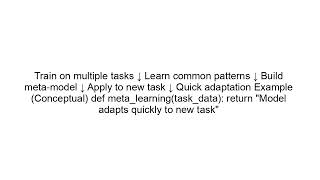
Meta learning is a subfield of machine learning that focuses on training models to learn from other models and adapt to new tasks quickly. This approach enables models to learn from their experiences and apply that knowledge to new situations. By doing so, meta learning aims to create more flexible and generalizable models that can handle a wide range of tasks.
Think of meta learning like a master chef who has learned to cook many different dishes. Imagine that the chef can take the skills and techniques they have learned from cooking one dish and apply them to cooking a new dish, even if they have never made it before. This is similar to how meta learning works, where a model learns to learn from its experiences and apply that knowledge to new tasks, much like the chef applies their culinary skills to new dishes.
Why does Meta Learning matter?
Meta learning matters because it has the potential to revolutionize the way we approach machine learning. Traditional machine learning models require large amounts of task-specific training data, which can be time-consuming and expensive to obtain. Meta learning offers a way to leverage the knowledge gained from one task to improve performance on another task, making it a promising approach for applications where data is scarce or limited. This is particularly relevant in areas like natural language processing, where models like transformers have shown great promise.
How does Meta Learning work?
Meta learning works by training a model on a set of tasks, and then using that experience to learn a new task. This is often done using a few-shot learning approach, where the model is trained on a limited number of examples from the new task. The key idea is to learn a set of generalizable features or patterns that can be applied to the new task, rather than learning task-specific features. This can be achieved through techniques like embeddings, which allow the model to represent tasks in a shared space.
Real-world applications
Meta learning has many real-world applications, including few-shot image classification, natural language processing, and reinforcement learning. For example, a meta learning model can be trained to recognize objects in images, and then adapt to recognize new objects with only a few examples. Similarly, a meta learning model can be used to improve the performance of a chatbot by learning from its interactions with users and adapting to new topics or languages.
Common misconceptions
One common misconception about meta learning is that it is a replacement for traditional machine learning. However, meta learning is actually a complementary approach that can be used in conjunction with traditional machine learning techniques. Another misconception is that meta learning requires a large amount of data, when in fact it can be used with limited data and can even help to reduce the need for large amounts of training data.
Future directions
Meta learning is a rapidly evolving field, with many potential applications and areas of research. As the field continues to grow, we can expect to see more developments in areas like few-shot learning, transfer learning, and multi-task learning. Additionally, meta learning has the potential to be used in conjunction with other AI concepts, like training data and embeddings, to create even more powerful and generalizable models.