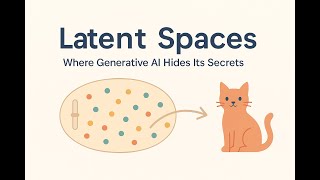
Latent space is a concept in artificial intelligence that refers to a compressed representation of complex data. This compressed version captures the most important features and patterns in the data, making it easier to work with. By reducing the dimensionality of the data, latent space helps to eliminate noise and irrelevant information. It's a fundamental idea in machine learning and deep learning, enabling models to learn from data more efficiently.
The term 'latent' means 'hidden' or 'underlying', which is fitting because the patterns and structures in the data are not immediately visible. To uncover these hidden patterns, machine learning algorithms use various techniques to map the original data to a lower-dimensional space. This process is called dimensionality reduction, and it's a crucial step in many AI applications. By transforming the data into a more compact and meaningful representation, latent space facilitates tasks like data visualization, clustering, and anomaly detection.
One of the key benefits of latent space is its ability to reveal relationships and structures in the data that would be difficult to discern in the original high-dimensional space. For instance, in image processing, latent space can help to identify common features among different images, such as shapes, textures, or objects. This can be useful for applications like image classification, object detection, and image generation. Moreover, latent space can be used to generate new data samples that are similar to the original data, which is useful in applications like data augmentation and synthetic data generation.
Latent space is not unique to AI; it has roots in statistics and information theory. However, the concept has gained significant attention in recent years due to the rise of deep learning and generative models. These models, such as Variational Autoencoders (VAEs) and Generative Adversarial Networks (GANs), rely heavily on latent space to learn complex data distributions and generate new data samples. The study of latent space is an active area of research, with many potential applications in fields like computer vision, natural language processing, and robotics.
In summary, latent space is a powerful concept in AI that enables the compression and simplification of complex data. By capturing the underlying patterns and structures in the data, latent space facilitates a wide range of applications, from data visualization and clustering to image generation and synthetic data creation. As AI continues to evolve, the study of latent space is likely to remain a vital area of research, with many exciting developments and innovations on the horizon.
Think of latent space like a library where each book represents a complex data point. Imagine each book being condensed into a concise summary, capturing the main ideas and themes, and stored in a smaller, more organized space. This summary, or latent representation, allows you to quickly grasp the essence of the book without having to read the entire thing, making it easier to find related books or identify patterns among different books. Similarly, latent space provides a compact and meaningful representation of complex data, enabling AI models to learn from it more efficiently.