What is Sparse Mixture of Experts?
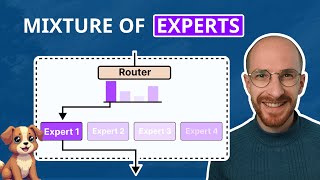
Sparse Mixture of Experts (SMoE) is a design where a large collection of small neural networks—called experts—compete to process each input, but only a handful are chosen to run. The selection is done by a gating network that decides which experts are most relevant for the current data point.
Think of a restaurant kitchen with many specialized chefs—one for sushi, one for pizza, one for desserts. When an order arrives, the manager (the gate) calls only the chefs needed for that dish, so the kitchen works quickly even though it has a huge staff.
Why does it matter?
Practitioners care because SMoE lets you build models with billions of parameters while keeping inference cost low. By turning on only a few experts per request, you get the expressive power of a huge model without the proportional slowdown or energy use. This makes it possible to scale AI systems for products that need fast responses and affordable cloud bills.
How does it work?
First, a lightweight gate receives the input and outputs scores for every expert. It then picks the top‑k experts (often 2 or 4) and sends the input to them. Each selected expert processes the data and returns its output. The gate also returns a weight for each expert, so the final result is a weighted sum of the expert outputs. During training, the gate learns which experts are best for which patterns, while each expert learns to specialize. Because only a few experts run, the overall compute stays sparse even though the total number of experts can be huge.
Real-world applications
1. **Search engines**: SMoE can tailor ranking models to different query types—news, shopping, or local results—by activating experts that specialize in each domain, improving relevance without slowing down the search.
2. **Language services**: Large translation platforms use SMoE to handle many language pairs; an expert may focus on French‑English, another on low‑resource languages, allowing a single model to cover dozens of pairs efficiently.
3. **Recommendation systems**: E‑commerce sites route user behavior through experts that know specific product categories, delivering personalized suggestions while keeping latency low.
Common misconceptions
*People often think SMoE always yields a smaller model.* In reality, the total parameter count can be massive; the savings come from activating only a subset at inference time.
*Another myth is that the gate is a bottleneck.* Modern implementations use fast, parallelizable gating (e.g., softmax or top‑k selection) that adds negligible overhead compared to the expert computations.
Overall, SMoE blends the flexibility of modular design with the efficiency of sparse activation, making it a powerful tool for scaling AI responsibly.