What is Neural radiance cache?
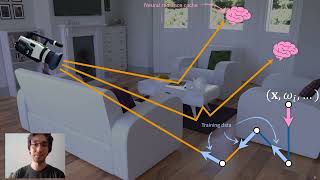
Neural radiance cache (NRC) is a data structure that records how light behaves at many points in a 3D scene, using a small neural network to predict color and brightness. It lets a renderer reuse this cached information instead of recomputing lighting from scratch for every pixel.
Think of a neural radiance cache like a restaurant’s menu: the chef (full ray tracing) prepares a few signature dishes, the menu (the tiny neural network) lists their flavors, and diners (the renderer) can order instantly without watching the cooking process each time.
Why does it matter?
Rendering realistic images or videos of complex environments can be extremely slow because light must be traced many times. NRC reduces that cost, making high‑quality visuals feasible for interactive applications such as games, VR, and product visualizations. For product managers and designers, faster rendering means quicker design iterations and lower compute budgets.
How does it work?
First, the system samples a few points in the scene and runs a full light‑transport simulation (often via ray tracing). The results—position, view direction, and radiance—are fed into a tiny neural network that learns a continuous function mapping location and direction to color. This network becomes the cache. When later frames need lighting, the renderer queries the network instead of launching expensive rays, interpolating the learned radiance across nearby points. The cache can be updated incrementally as the scene changes, keeping the predictions accurate.
Real-world applications
1. **Virtual product showcases** – Companies can generate photorealistic 3D product views on the web without long server‑side rendering times. 2. **Game engines** – NRC enables real‑time global illumination on consoles, improving visual fidelity while staying within frame‑budget limits. 3. **Architectural walkthroughs** – Designers can explore lighting‑rich interiors instantly, helping clients make decisions faster.
Common misconceptions
*People think NRC eliminates all ray tracing.* In reality, the cache relies on an initial ray‑traced pass to learn lighting; it merely reduces the number of subsequent rays. *Another myth is that the neural network always produces perfect results.* The quality depends on how well the cache is trained and how dynamic the scene is; rapid changes may require cache refreshes.
Related terms you may encounter include neural rendering, global illumination, and differentiable rendering, all of which share the goal of blending AI with classic graphics pipelines.