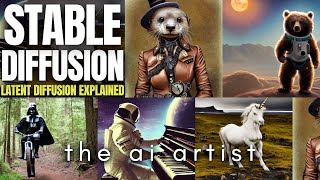
What is Latent Diffusion?
Latent diffusion is a technique used in artificial intelligence to generate high-quality images from text prompts. It involves the use of diffusion models, which progressively refine the input until a realistic image is produced. This process is often compared to other image generation techniques, such as those using transformers or embeddings, but latent diffusion has shown remarkable results in terms of image quality and diversity.
Think of latent diffusion like a sculptor refining a block of clay. Imagine starting with a rough shape and progressively refining it until a beautiful and intricate sculpture is revealed. Similarly, latent diffusion starts with a random noise vector and progressively refines it until a realistic image is produced. Just as the sculptor uses different tools and techniques to refine the clay, latent diffusion uses a series of transformations to refine the input until a high-quality image is generated.
Why does Latent Diffusion matter?
Latent diffusion matters because it has the potential to revolutionize the field of computer vision and image generation. Practitioners and builders care about this technique because it can be used to generate realistic images for a variety of applications, such as art, design, and entertainment. Additionally, latent diffusion can be used to improve the performance of other AI models, such as those using training data or embeddings, by generating new and diverse images for training.
How does Latent Diffusion work?
Latent diffusion works by using a diffusion model to progressively refine the input until a realistic image is produced. The process starts with a random noise vector, which is then transformed into a more refined representation through a series of transformations. The model is trained on a large dataset of images, which allows it to learn the patterns and structures of the data. This process is similar to other techniques, such as generative adversarial networks, but latent diffusion has shown to be more efficient and effective.
Real-world applications
Latent diffusion has a variety of real-world applications, including art, design, and entertainment. For example, it can be used to generate realistic images of products for e-commerce websites, or to create special effects for movies and video games. Additionally, latent diffusion can be used to improve the performance of other AI models, such as those using training data or embeddings, by generating new and diverse images for training. It can also be used in fields such as architecture and engineering to generate designs and prototypes.
Common misconceptions
One common misconception about latent diffusion is that it is a type of generative adversarial network. While both techniques are used for image generation, they work in different ways and have different strengths and weaknesses. Another misconception is that latent diffusion requires a large amount of training data, but in reality, it can be trained on relatively small datasets and still produce high-quality results.
Future directions
The future of latent diffusion is exciting and rapidly evolving. As the technique continues to improve, we can expect to see more realistic and diverse images being generated. Additionally, latent diffusion can be combined with other techniques, such as transformers or embeddings, to create even more powerful and flexible models. This can lead to breakthroughs in a variety of fields, including computer vision, natural language processing, and robotics.