What is Diffusion Transformer?
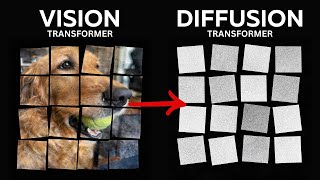
A Diffusion Transformer is a neural model that combines the iterative denoising process of diffusion models with the self‑attention mechanisms of transformers. It generates data—most often images—by progressively refining random noise, while using transformer layers to capture global structure.
Think of a Diffusion Transformer as a sculptor starting with a block of marble (random noise) and using a detailed blueprint (the transformer’s attention) to chip away layer by layer until a polished statue emerges.
Why does it matter?
Practitioners care because it unites two powerful ideas: diffusion models produce photorealistic results, and transformers excel at handling long‑range dependencies. The hybrid can achieve higher fidelity and faster convergence than using either approach alone, making it attractive for commercial content creation and research.
How does it work?
First, a diffusion process adds noise to a clean image in many small steps, creating a noisy target sequence. The model learns to reverse this process: starting from pure noise, it predicts a slightly less noisy version at each step. Instead of a simple convolutional network, the reverse step is performed by a transformer encoder‑decoder that attends to the entire noisy image and any conditioning signals (like text prompts). The attention mechanism lets the model consider relationships across the whole picture, guiding the denoising toward coherent shapes and colors. Training optimizes a loss that measures how well the predicted denoised image matches the true one at each step.
Real‑world applications
1. **Text‑to‑image generation**: Users type a description, and the Diffusion Transformer produces a detailed illustration that respects both global composition and fine details.
2. **Video frame interpolation**: By treating consecutive frames as a sequence, the model can fill in missing frames, creating smooth slow‑motion video.
3. **Design prototyping**: Product teams can quickly generate multiple visual concepts from brief prompts, speeding up ideation cycles.
Common misconceptions
*People often think the transformer part replaces the diffusion process entirely.* In reality, the transformer is a component of the denoising step; the iterative diffusion framework remains essential.
*Another myth is that diffusion models are always slow.* While they require many steps, the transformer’s parallel attention can reduce the number of required steps compared with pure convolutional diffusion models, leading to faster inference in practice.